

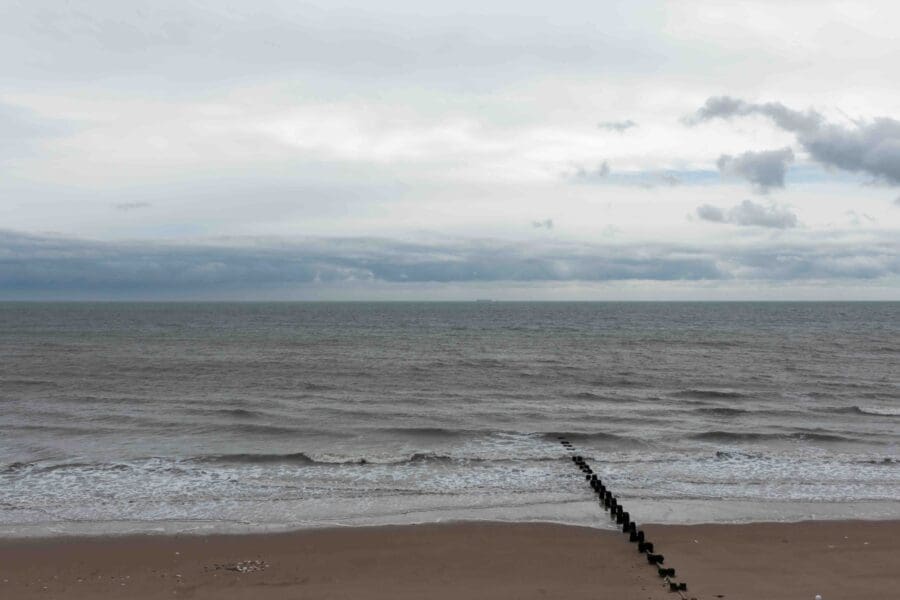
The list of climate change fiction is long and distinguished. Ben Smith’s desolate and dystopian 2019 debut novel, set in a future England seascape littered with off-shore wind turbines and very little else, is a modern genre landmark.
PICS: Getty
Doggerland’s story centres on a boy investigating his father’s death, at a time when sea level rise has swallowed up large swathes of the United Kingdom and North West Europe. The book is entirely fiction, but its name is borrowed from a very real region lost beneath North Sea waves millennia ago.
Archaeologists have been fascinated by the real life Doggerland since evidence was first discovered in 1913. British geologist Clement Reid was studying artefacts dredged up from the murky tidal depths by fishermen. Tree stumps. Mammoth bones. Peaty deposits. All pointed to a forgotten prehistoric landscape that connected eastern England with Belgium, the Netherlands and Germany, presumably flooded when the last Ice Age ended.
Civilisation and conservation
The signs of a thriving civilisation living in this coastal region are even more remarkable. Stone and flint tools, human remains, and even submerged settlements have all been identified. Underwater research has also revealed river valleys and estuaries. The ghostly remnants of what historical writer Robbie Mitchell has described as “a veritable Garden of Eden.”
Carbon dating and other techniques show Doggerland was above the North Sea and inhabited as recently as 6,000 years ago. Academics believe people living here were nomadic hunter-gatherers. Their diet consisting of fish, foraged nuts and berries, and meats. Or, essentially, whatever was available seasonally.

More crucially, this ancient civilisation is widely believed to offer some clues as to how and when the earliest settlers to Britain would begin to adopt agricultural practices. Their forced relocation inland, triggered by rising global temperatures, eventually leading to a fundamental lifestyle change.
According to one of the most recent papers on Doggerland, published in the Proceedings of the National Academy of Sciences [PNAS], many temperate trees, like oaks, elms, and hazels, could have been present more than 16,000 years ago.
“From a human perspective, this is the best evidence that Doggerland’s wooded environment could have supported early Mesolithic communities prior to flooding and may help explain why relatively little early Mesolithic evidence survives on mainland Britain today,” says Professor Robin Allaby at the School of Life Sciences, University of Warwick, and lead author of the sedaDNA study of Doggerland.
Tsunami
A slightly different explanation for the fate of Doggerland has been posited by other scientists. The Storegga slides were a series of submarine landslides off the coast of Norway. Unfolding between 8,400 and 2,200 year ago, there’s no doubt this seismic event happened, with 60 miles of seafloor scarring still evident today. As the Encyclopaedia Britannica makes clear, there’s also unanimous consensus that this represents the largest slope failure anywhere in world history.
But other aspects of this natural disaster are more debated. For example, some estimates suggest that the event would have created waves between 65 and 80 feet high. The catastrophic tides would have hit a number of coastlines, including several on the North Sea. So was this the real, and much more sudden reason Doggerland vanished? If so, it would have wiped out almost the entire population in the process. There would have been little time, let alone the ability, to outrun the encroaching water.
Mapping Doggerland
In 1998 prehistory archaeologist Bryony Coles became the first person to publish maps of Doggerland. She based her geography on an existing relief in the North Sea. Admitting that this was entirely speculative, more professionals were called in.
Since then, estimates as to the region’s size, and guesses about who lived there, have become more sophisticated. Today it is understood this lost land extended over 18,000 square miles. Most recently, the 21st Century has unearthed — or raised — even more clues. Investigations off the Dutch coast have led to discoveries of textiles, domestic dwellings, canoes and traps. All had been waiting to be found, just a few fathoms below.
Atlantis in reverse (and a warning from the past)
Historic Mysteries describes Doggerland as a kind of reverse Atlantis. The fabled underwater city which has been part of the common oceanic folklore conscious for aeons. In comparison, the North Sea has been so effective at hiding its secrets there’s little-to-no mention of Doggerland, a very real place, in European legend. Perhaps if there had been, we would be in a better place to face our own reality now.
Above all else, Doggerland is an example of what can and does happen when the world heats up. Melting ice caps and the increased flow of water into oceans and seas only leads to one outcome. A significant rise in the tide line. With potentially catastrophic consequences.
Even if the Storegga slides theory is true, the underwater landslide would have been directly caused by vast ice sheets melting. In turn, this led to sediment layers becoming unstable. A stark reminder of the ripple effects that follow cataclysmic shifts in the natural world.


