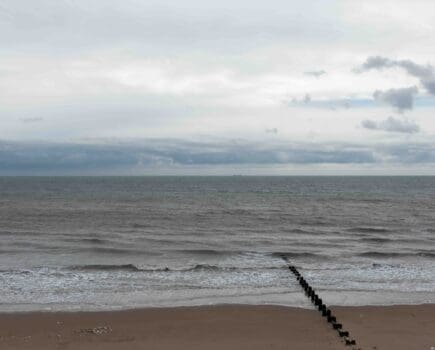


Calvert Cliffs State Park, in Lusby, Maryland, isn’t just a scenic spot for a walk on the beach—it’s also one of the top places to find fossils from the Miocene epoch.
While state parks offer us incredible places to recreate, relax, and exercise, few have the ability to visually transport us back in time to the Miocene epoch.
However, Maryland’s Calvert Cliffs State Park isn’t like other parks. Located in Lusby, Maryland, this scenic park is known for its towering cliffs and rich fossil deposits. Today, it sits within the Chesapeake Bay watershed, but 10-15 million years ago, during the Miocene epoch, the entire park, and most of Maryland, was underwater, covered by a warm, shallow ocean.
This ocean is now known as the Miocene Sea. Any time travellers lucky enough to visit Maryland at this time would have come across temperate waters surrounded by tidal wetlands, swamps, and a humid and warm climate, similar to Florida today. The Miocene Sea was home to an array of diverse marine species, including whales, turtles, sharks, and reptiles.
When the sea later receded, it created the popular sandy beaches that make up the park today—and also left a huge array of fossils in many layers of sediment. Over 600 species of fossils have been found within Calvert Cliffs State Park, making it an incredible destination for anyone interested in prehistoric history.
Walking along the sandy beach and tide lines, visitors can find fossilised bones and shells from species including oysters, scallops, whales, seabirds, and stingrays. They offer tangible and fascinating reminders of what the park would have been like millennia ago.

However, perhaps the most famous fossils found at Calvert Cliffs are megalodon teeth. The world’s largest prehistoric shark, the now-extinct megalodon was up to three times the length of modern-day great white sharks and weighed up to 50 tons. Megalodons were a type of mackerel shark, a species which includes great white and mako sharks. The megalodon was a true apex predator of the seas, with an estimated bite strength of 40,000 pounds, strong enough to crush a car.
While it’s hard to imagine such an imposing and fierce inhabitant in our seas today, fossils like the ones found in Calvert Cliffs can help us learn more about what megalodons looked like. While they aren’t the most common fossil found within the park, in 2023, then nine-year-old Molly Sampson, who was fossil hunting with her family, found a five-inch-long megalodon tooth from an individual estimated to be 45 to 50 feet long.
“It’s a spectacular specimen. It’s one of the larger ones that’s probably ever been found along Calvert Cliffs and might be a ‘once-in-a-lifetime kind of find’,” Stephen Godfrey, curator of palaeontology at the nearby Calvert Marine Museum, told NPR.
Even if you don’t stumble across a megalodon tooth when you visit, many other shark species also lived in the Miocene Sea and have left fossil remnants behind, including sand, tiger, mackerel, and requiem shark species.
Sharks continually replace lost teeth, rather than having one set of teeth for life, as humans have. Their need to constantly grow new teeth throughout a shark’s lifetime plays a large part in why so many shark fossils have been found at Calvert Cliffs, and continue to be found regularly.
If you’re keen to visit for yourself, Calvert Cliffs State Park is a scenic day trip. It’s just under a 90-minute drive from either Baltimore or Washington, D.C., located on the western shores of the Chesapeake Bay. The park is open daily from sunrise to sunset, with a park entrance fee of $5.00 per vehicle for Maryland residents and $7.00 per vehicle for out-of-state vehicles.
Keep in mind that the park is popular with locals, and if the parking lot becomes full, park staff may have to turn visitors away—so it never hurts to arrive early.

Visitors are allowed to keep any fossils they find, but strict rules are in place regarding collection access. Fossil hunters visiting the park can collect specimens from the shoreline and beach, but not from the cliff itself. Walking under or climbing onto the cliffs isn’t allowed, as their instability can present a safety risk. Fossil collection is limited to one beach within the park, accessible via the Red Trail, approximately 1.8 miles from the main parking lot.
The best odds of spotting fossils are during low tide, so it’s worth consulting NOAA Tide Predictions before you go. Or, visiting after a storm has come through and churned up layers of sediment, unearthing hidden fossils, can also increase your chances of success.
While you’re in the area, it’s also worth visiting the Calvert Marine Museum, just a five-mile drive from Calvert Cliffs. It’s home to many fossils found within the park, along with a Miocene Sea diorama and a skeletal restoration of the extinct Miocene giant white shark. Or, Flag Ponds Nature Park is another local park in Lusby where fossils are sometimes found, if you want to keep searching.
A visit to Calvert Cliffs State Park is not only a fun day out to look for fossils, but also offers a rare example of a landscape that so uniquely combines modern-day coastal beauty with prehistoric history.