


This unique California beach features something you don’t see every day—purple sand, thanks to the deposits of manganese garnet in the cliffs of the Big Sur Coast.
While the white sand beaches of the Caribbean and the black sand beaches of Hawaiʻi are well known, California rivals them both with something completely unique—a purple sand beach.
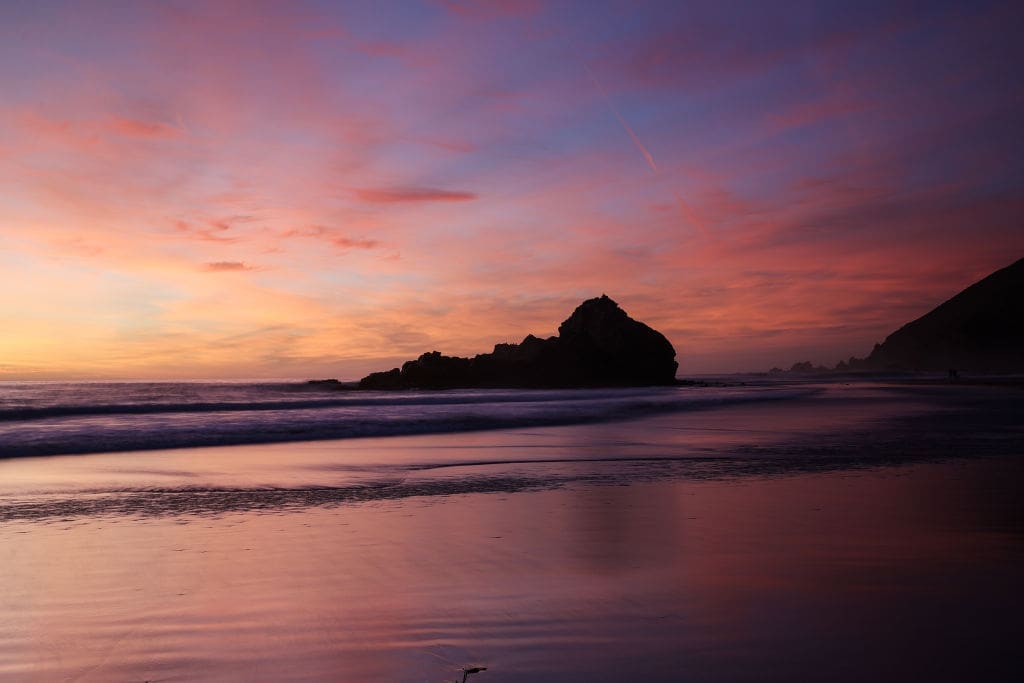
In Big Sur, a dramatic, mountainous stretch of California’s Central Coast, Pfeiffer Beach attracts visitors eager to see its unique phenomenon: purple-tinted sand. With swirls of vibrant violet colouring, combined with Keyhole Arch, a natural offshore rock formation, Pfeiffer is one of the most surreal beaches on the West Coast to visit, photograph, or just admire.
The science behind the purple sand
The reason Pfeiffer Beach features its intriguing purple colouring is due to unique geography. It’s one of the world’s rare purple beaches due to the deposits of spessartine garnet nearby, a type of manganese garnet. The Santa Lucia Mountains that surround the beach naturally contain spessartine within the rocks and cliffs.
Spessartine is a type of silicate mineral with a glasslike shine. It has a hardness of 7 to 7.5 on the Mohs scale, making it a desirable gemstone in jewellery. It’s found in both igneous and metamorphic rock that contains manganese, not just in California, but also in a range of other locations. These include Namibia, Madagascar, China, and Germany.
Peter Adams, a professor of geological sciences at the University of Florida, explained to Reader’s Digest why it’s found at Pfeiffer.
Adams said, “Along the Big Sur coast, the sea cliffs are composed of metamorphic rocks that have been altered by extreme temperatures and pressures, which commonly create metamorphic minerals such as garnets. Because this sediment source is nearby, it’s not surprising the spessartine is found in higher concentrations at this beach.”
As erosion and rain occur over time, they cause tiny breakdowns in the rocks. This washes the spessartine down from the cliffs and onto the beach. Once the purple particles are on the beach, they mix with the normal quartz sand. This creates beautiful plum-hued patches and swirls of coloured sand.
Visiting Pfeiffer Beach
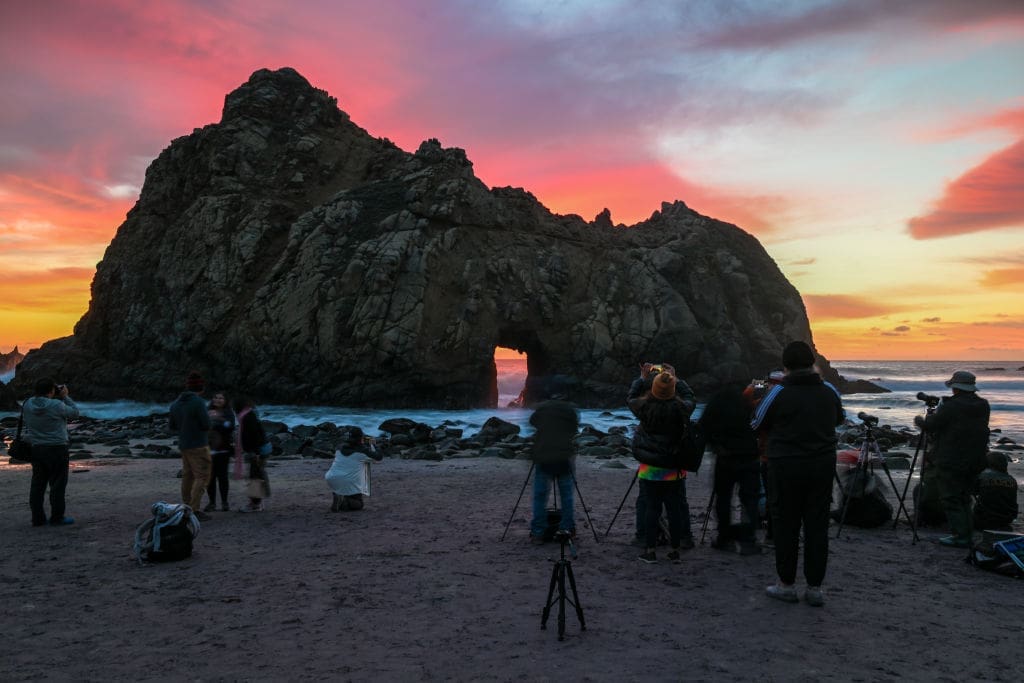
Although the violet-hued sand is enough of a reason to visit, Pfeiffer Beach is also well worth seeing for the unique Keystone Arch. A sea stack made from soft, sedimentary rock, incessant crashing waves eroded the lower part of the stack over time, creating a tunnel through the formation. It now stands as an offshore rock bridge, with sunlight beaming through if you visit at just the right time.
Pfeiffer Beach, and the Big Sur coastline in general, are very popular tourist destinations within California. As a result, the beach’s limited parking can fill up quickly. Pfeiffer is within Los Padres National Forest, managed by the U.S. Forest Service. There is a $15.00 USD day-use fee to park, with picnic tables and basic restroom facilities available.
Although the beauty of the beach can be hard to resist, it’s actually not a great spot for swimming. There are no lifeguards on duty. The ocean can be deceptively dangerous, with icy-cold water temperatures, rip currents, and large rocks not visible from the surface.
Finding Pfeiffer Beach can be tricky, as the turnoff from Highway 1 onto Sycamore Canyon Road is easy to miss. When driving, note that it’s between the Big Sur Ranger Station and the Post Office.
To observe the beach at its most vibrant, try to visit right after a heavy rainstorm. When it rains, the water brings more manganese garnet down from the cliffs, washing it down onto the sand. Try to also time your arrival to low tide. The receding water reveals more of the concentrated purple colouring in the sand.
For visitors hoping for the perfect photo of sunlight streaming in through Keyhole Arch, plan ahead. The golden light tends to come directly through in the winter months, around 30 minutes before sunset.
Does the US have any other coloured sand beaches?
Although it’s rare, you can find other beaches within the United States with unexpected sand colouring. Papakolea Beach, on the island of Hawaiʻi, is known for its unique green sand. This comes from the moss-green mineral colouring within magnesium iron silicate, also called olivine.
The olivine crystals were originally deep in the volcanic ring around the island. After eruptions, they became embedded in the sand.
Shelter Cove, along the remote Lost Coast of California’s Humboldt County, is a spectacular black sand beach that’s also worth a visit. With fine black volcanic sand, the dramatic views of the beach are framed by the King Range mountains. It’s not easy to access, but once you’re there, it’s home to some incredible hiking trails and pristine dark skies for stargazing.