
In the late-1960s a cargo ship bound for Brazil wound up wrecked on the islands of Cabo Verde. What happened next changed a nation’s culture
PICS: Getty
Cabo Verde is no stranger to shipwrecks. A tiny archipelago floating off the northwest coast of Africa, the island nation boasts countless rugged and rocky bays. Not to mention spectacular beaches, like Praia de Atalanta.
A place where undulating sand dunes tumble into the endless Atlantic Ocean. For many people, it’s one of the most jaw-dropping stretches of sand in the world.
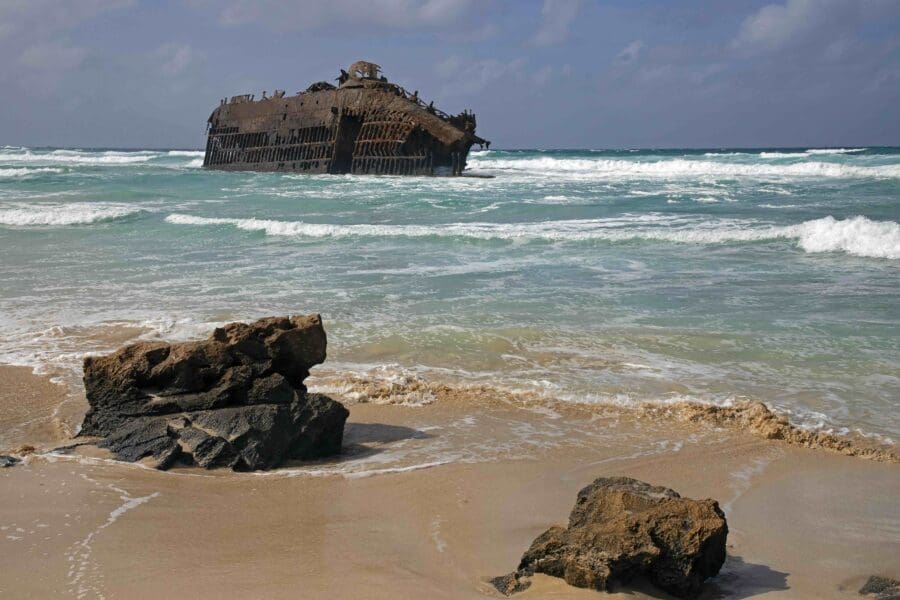
For others, the rusted remains of the 126-metre Spanish freighter MS Cabo Santa Maria is the main reason to visit, a shipwreck dramatically jutting out of the waves. Over time, its shell has become a popular diving spot.
Submerged shards of salt-chiselled and water-damaged metal now act as a man made reef. Rather than an eyesore, the site is an artificial home for the country’s world famous fish and other marine life.
The corpses of more than 70 other vessels lie in and under the waters of this 10 island-chain. All of which met their fate between the 16th and 19th Centuries. Of these, some come with their own well-known stories. Meanwhile, others remain the subject of speculation. But the most bizarre and baffling maritime mystery of all unfolded inland, much more recently.
A ship that brought future sounds to remote islands
In spring 1968, a cargo ship set sail from Baltimore, USA. Its destination was Rio de Janeiro, where the EMSE Exhibition was taking place. The event was South America’s first ever expo of electronic music instruments, and a bounty of what would now be considered priceless rare machines sat in the vessel’s hold.
Early products by Moog, Hammond and Korg. Kit that has since helped create innumerable groundbreaking and chart-topping albums. But none ever made it to Brazil. Instead, the boat vanished.
Maritime officials presumed it had sunk somewhere en route. If only things were so simple.
Months later, the boat reappeared 8 kilometres from shore in Cachaço, São Nicolau – a tiny village on one of Cabo Verde’s rockiest and most mountainous islands, an ocean away from its intended port. The crew had vanished, but the hoard of keyboards, synths, and other devices was still very much in tact.
At first, the locals were unimpressed by the strange machines. Unfamiliar boxes which they had no use for. They were also baffled as to how a large boat had wound up in their inland whistlestop. However, it wouldn’t be long before they started to change their tunes.
Finding a place to plug in
At this time, Cabo Verde was in the final years of Portuguese colonial rule. Like many African countries, ideas of revolution hung in the air. And with hindsight, independence wasn’t far away.
African poet and staunch anti-imperialist Amílcar Cabral was one of the loudest voices calling for change. He was also the man who quickly instructed people to collect every synth they could find.
He wanted to distribute the equipment amongst schools, churches, and community hubs. But this had to be done before the ruling powers discovered what had happened, and prying European eyes were always on the lookout for anything out of the ordinary. Those considered a threat to the established order faced fierce reprisals.
First, though, there was another problem: figuring out where the loot should be stashed. Easier said than done, back then most of Cabo Verde’s buildings still didn’t have electricity. So the latest audio sequencer or sampler would be useless in the majority of places, as people wouldn’t be able to plug them in. Finally, the villagers agreed on a solution. Speaking in the documentary, A Sweet Pain, musician Telo Peres explains what happened.
“Cabral told them to take the instruments to the lowlands. One of the few places with electricity, saying that ‘no Portuguese will think to look there.’”
Making music
After a few weeks, Cabo Verdeans began experimenting with what they found. Historic island folk styles like morna, coladeira and funaná fused with more futurist tones. The sort of sounds only possible with what were, back then, state of the art instruments from the world’s most pioneering music manufacturers.
Before long, Portuguese authorities also heard those noises. A government desperately clinging to power came down hard on what it considered an emerging social danger. A cultural phenomenon promoting a new modern identity for the islands. But it was already far too late.
People had no teachers nor experienced musicians to show them how to use the equipment. Nevertheless, through trial and error an underground movement blossomed from opportunity, experimentation and energy.
Stars emerged, like celebrated arranger Paulino Vieira. An artist who, amongst other things, combined the ferrinho, essentially an iron bar and knife instrument typical of the region, with cosmic effects, loops, and more. Before long, these wild sci-fi sounds were seemingly everywhere, prevalence growing in tandem with the push for nationhood and freedom.
Did it really happen?
Cabo Verde eventually claimed independence in 1975, and that declaration triggered a tidal wave of electronic music output. A moment of cultural transformation that still defines those immediate post-colonial years.
Remarkably, all this happened at a time when Europe and the US were also only just beginning to understand what synthesisers could do. Even though they designed and built them.
If all this seems like a myth, the fact no account of the story seems to mention the name of the cargo ship probably won’t help convince you. Nor the claims that people actually found that boat in the Atlantic shallows, rather than a small village. Then there are the few who dispute whether any of this happened at all. But there is plenty of evidence worth listening to.
An album, for the record
In 2019, Frankfurt, Germany-based music label Analog Africa, which specialises in unearthing rare and forgotten African tunes, released a selection of tracks made after the cargo ship was discovered.
These are still available on the album Space Echo – The Mystery Behind The Cosmic Sound Of Cabo Verde. However, the liner notes throw up as many questions as they answer.
“Portuguese scientists and physicians were ordered to the scene and after weeks of thorough studies and research, it was concluded that the ship had fallen from the sky. One of the less plausible theories was that it might have fallen from a Russian military air carrier. The locals joked that again the government had wasted their tax money on a useless exercise.
“What the villagers didn’t know, was that traces of cosmic particles were discovered on the boat. The bow of the ship showed traces of extreme heat, very similar to traces found on meteors, suggesting that the ship had penetrated the hemisphere at high speed. That theory also didn’t make sense as such an impact would have reduced the ship to dust. Mystery permeated the event.”