

A sunken jumbo jet, Boeing 747, is the centrepiece of a themed diving site off the coast of Bahrain, attracting both human divers and underwater wildlife
PICS: Getty images Words: Dominic Bliss
Air Atlanta Icelandic used to have an old Boeing 747 that flew cargo for its fleet. During its 38-year lifetime, it criss-crossed the world, also serving for Malaysia Airlines and Focus Air.
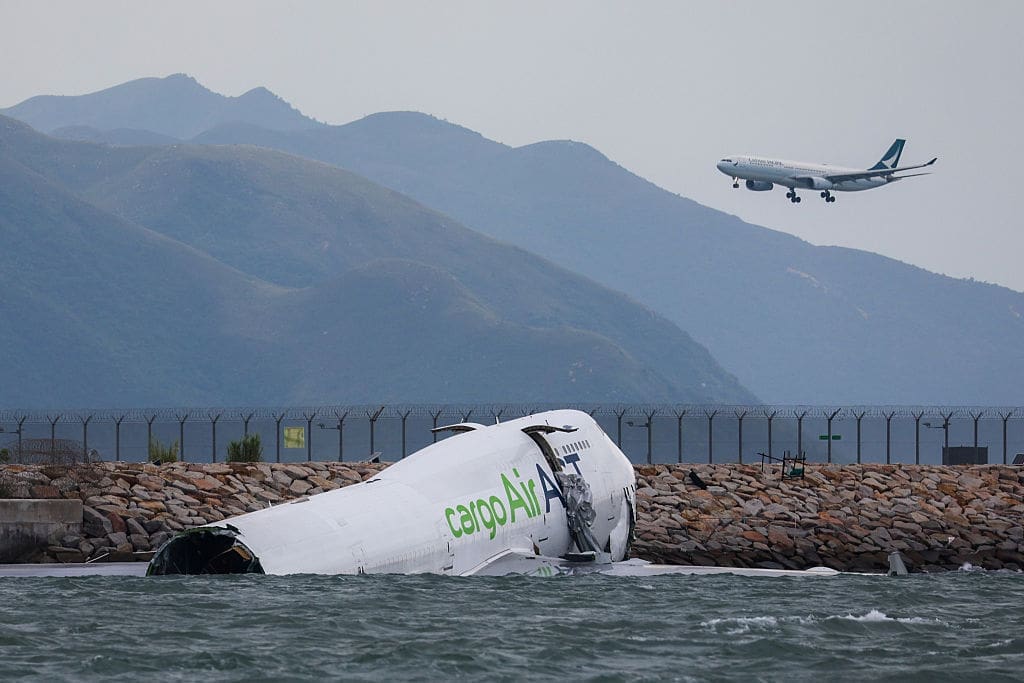
Right now, that overworked aeroplane is sitting 20 metres down at the bottom of the Arabian Gulf, off the coast of Bahrain. It’s the centrepiece of what the Bahrani government claims is “the world’s largest underwater theme park”.
Submerged across the 100,000-square-metre site, there are also artificial coral reefs, tugboat wrecks and various marine-inspired sculptures. Divers can access the park through government-licensed dive centres. Some of the shallower features are ideal for beginners while others are accessible only to experts.
The project, which first opened in 2019, is the brainchild of the Bahrain Tourism and Exhibitions Authority. “We want this to have as broad an appeal as possible,” said a spokesman for the park.
Bringing a 70-metre-long decommissioned Boeing 747-200 out into the Arabian Gulf was no mean feat of engineering. The last flight this plane made ended at Fujairah International Airport in the United Arab Emirates. The previous owners had planned to repurpose it for future flights but it proved economically unviable, which is when the Bahrain Tourism and Exhibitions Authority took possession of it.
Once all the valuable components had been salvaged, the Boeing’s engines, landing gear and wings were then removed. All these parts plus the main fuselage were transported by road to a nearby port, and then by barge to northern Bahrain. Here, it was finally stripped down to its bare aluminium shell, which involved “removing wires, hydraulics, aerial and fuel systems, adhesive, plastic, rubber, chemical materials and all possibly toxic substances”.
Finally, the wings were reattached, and the entire craft was floated on huge airbags out to the dive site, before it was sunk and positioned in its final resting place.
But will the metal shell itself – a mixture of cast and sheet aluminium – damage the marine environment?
The spokesman for the park insists not. “The speed of the marine growth over the top of the aluminium will probably be quicker than any oxidation, so we’re not going to get any rust,” he said. “If anything, it will go like a soda can does after 20 years in the water. It just becomes very, very thin.”
He added that the pH levels of the sea in the Arabian Gulf would react well with the aluminium and be “hospitable to marine growth”.
This is by no means the first aeroplane to be intentionally sunk to create a dive site. In 2016 an Airbus A300 airliner was submerged in the Aegean Sea, close to the Turkish town of Kusadasi. Three years later, also in Turkey, another Airbus A330 was lowered to the sea bed, this time near the town of Ibrice.
In 2017 a Lockheed C130 Hercules transport aircraft was sunk close to the Jordanian town of Aqaba, in the Red Sea.
Back in the 1990s, an old Boeing 727 was laid to rest off the coast of Miami. It later split in two after damage from Hurricane Gordon in 1995. There’s another Boeing 727 at Mermet Springs, a flooded limestone quarry and scuba diving park in Illinois. This plane was once used in a dramatic crash scene in the 1998 Hollywood thriller U.S. Marshals. Further north, in the Canadian state of British Columbia, there’s a Boeing 737 in the Stuart Channel, near the town of Chemainus.
While all these sunken relics offer great diving opportunities, they can serve a scientific purpose too. The owners of Dive Bahrain, for example, hope marine science students will use their park for research.
“The area we selected is pretty much a desert underwater,” said a spokesperson. “As soon as the Boeing was submerged, two days later we had schools of fish around the aircraft.”
Since then, barnacles have gradually attached themselves to the fuselage, while different species of fish have been lured into the area. “We think this park can offer a lot to university students,” a spokesperson said optimistically. “It will position Bahrain as a global leader in the field of marine wildlife preservation.”